Ingolstadt Contents Geography History and culture Demographics Cityscape Schools Sports Literary references International relations Organizations and clubs Notable people See also References External links Navigation menu48°46′N 11°26′E / 48.767°N 11.433°E / 48.767; 11.43348°46′N 11°26′E / 48.767°N 11.433°E / 48.767; 11.433www.ingolstadt.demuseum of the Bavarian army[update]"Alle politisch selbständigen Gemeinden mit ausgewählten Merkmalen am 31.12.2018 (4. Quartal)"the original"Fortschreibung des Bevölkerungsstandes""Bevölkerung"Archived"Facts and Figures"Archived"Miasta Partnerskie Opola"the original"Aktuelles Detail"Archived"Ingolstadt und Foshan"ArchivedIngolstadtVirtual tour through IngolstadtCatholic University Eichstätt-IngolstadtUniversity of Applied Sciences (Fachhochschule)Museum of the Bavarian ArmyAudiA history of Ingolstadt by Kurt ScheurerA biography of Marieluise FleißerPioniere in Ingolstadt by Marieluise Fleißereee4026991-7n8012869794cf91c4-9ef4-4af9-b011-9d723e86c3c310046153132524888132524888
AmbergAnsbachAschaffenburgAugsburgBambergBayreuthCoburgErlangenFürthHofIngolstadtKaufbeurenKemptenLandshutMemmingenMünchen (Munich)Nürnberg (Nuremberg)PassauRegensburgRosenheimSchwabachSchweinfurtStraubingWeidenWürzburg
Cities in BavariaIngolstadtPopulated places on the Danube
BavariaDanubeMunich Metropolitan RegionAge of Enlightenmentsecret societyMary ShelleyVictor FrankensteinAudiAirbusMedia MarktSaturnIngolstadt Central StationNurembergIngolstadt NordKipfenbergabove sea levelabove sea levelCharlemagneDuchy of Bavaria-IngolstadtBavaria-LandshutLouis VII, Duke of BavariaNew CastleFrench Gothic architectureLouis IX, Duke of BavariaUniversity of IngolstadtLudwig-Maximilians-UniversityLandshutMunichUniversity of IngolstadtJohann EckWilliam IV, Duke of BavariaReinheitsgebotBlack CompanyFranconianGerman Peasants' Warlast standSwabian Leaguefield marshalJohann Tserclaes, Count of TillySwedishGustavus AdolphusGermanyAdam WeishauptIlluminatiLandshutmedievalmuseum of the Bavarian armyWorld War IFrenchCharles de Gaulleprisoner of warsappersMarieluise FleißerAuto UnionChemnitzZwickauEast GermanywarreparationsMarshall PlanAudi companyVolkswagenLandshutMunichStraubingBurghausenNew CastleKreuztorAsam brothersJohann Michael FischerLeo von KlenzeAudimuseum mobileGlacisKlenzeparkIngolstadt State FortressLandesgartenschauIngolstadt School of ManagementCatholic University of Eichstätt-Ingolstadtbachelor'smaster's degreesMBAMTV 1881 Ingolstadtice hockeyassociation footballERC IngolstadtGerman Ice Hockey LeagueFC Ingolstadt 04Regionalliga Süd2. BundesligaBundesligaRobert SheaRobert Anton WilsonMother Courage and Her ChildrenBertolt BrechtThirty Years WarRainer Werner FassbinderPioneers in IngolstadtUniversity of IngolstadtTerra Ignota
Ingolstadt | |
|---|---|
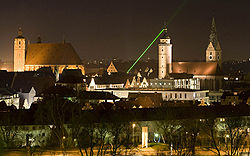 Ingolstadt by night | |
 Flag  Coat of arms | |
Location of Ingolstadt | |
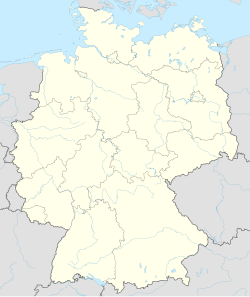  Ingolstadt Show map of Germany 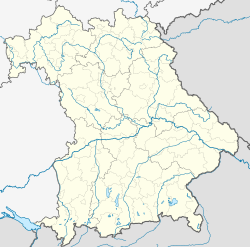 Ingolstadt Show map of Bavaria | |
| Coordinates: 48°46′N 11°26′E / 48.767°N 11.433°E / 48.767; 11.433Coordinates: 48°46′N 11°26′E / 48.767°N 11.433°E / 48.767; 11.433 | |
| Country | Germany |
| State | Bavaria |
| Admin. region | Oberbayern |
| District | Urban district |
| Government | |
| • Lord Mayor | Christian Lösel (CSU) |
| Area [1][2] | |
| • Total | 133.35 km2 (51.49 sq mi) |
| Elevation | 374 m (1,227 ft) |
| Population (2017-12-31)[3] | |
| • Total | 135,244 |
| • Density | 1,000/km2 (2,600/sq mi) |
| Time zone | CET/CEST (UTC+1/+2) |
| Postal codes | 85049–85057 |
| Dialling codes | 0841 08450 (Zuchering, Brunnenreuth) 08424 (Irgertsheim) 08458 (Pettenhofen/Mühlhausen/Dünzlau) 08459 (Niederfeld) |
| Vehicle registration | IN |
| Website | www.ingolstadt.de |
Ingolstadt (German pronunciation: [ˈɪŋɡɔlˌʃtat] ( listen); Austro-Bavarian: [ˈɪŋl̩ʃtɔːd]) is a city in Bavaria, Germany, on the banks of the River Danube, in the centre of Bavaria. In 2016, it had 133,638 citizens, making it the fifth largest city in Bavaria. It is part of the Munich Metropolitan Region.
The Illuminati, an Age of Enlightenment secret society, was founded in Ingolstadt in the late 18th century.
Ingolstadt is a setting in the novel Frankenstein by Mary Shelley, where the scientist Victor Frankenstein creates his monster.
It is the site of the headquarters of the German automobile manufacturer Audi, defence aircraft manufacturer Airbus (formerly Cassidian Air Systems), and electronic stores Media Markt and Saturn.
Ingolstadt Central Station has been connected to Nuremberg by a high-speed rail link since May 2006. Ingolstadt also has a second passenger station at Ingolstadt Nord.
Contents
1 Geography
2 History and culture
3 Demographics
4 Cityscape
4.1 Main sights
4.2 Parks and natural areas
5 Schools
5.1 Ingolstadt School of Management
5.2 THI University of Applied Sciences
6 Sports
7 Literary references
8 International relations
9 Organizations and clubs
10 Notable people
11 See also
12 References
13 External links
Geography
Covering an urban area of 133.35 square kilometres (51.49 sq mi), Ingolstadt is geographically Bavaria's fourth-largest city after Munich, Nuremberg and Augsburg. At its largest point the city is about 18 km (11 miles) from east to west and from north to south about 15 km (9 miles). The city boundary has a length of 70 km (43 miles).
The city boundary is about 14 km (9 mi) away from the geographic centre of Bavaria in Kipfenberg. The old town is approximately 374 metres (1,227 feet) above sea level and the highest point, located in the district of Pettenhofen, is 410.87 m (1,348.00 ft). The lowest point of the Schutter confluence with the Danube is at 362 m (1,188 ft) above sea level. Ingolstadt uses Central European Time as throughout Germany; the average time lag is 14 minutes.
The city is expanding at the northern and southern banks of the Danube in a wide flat bowl. The Ingolstadt basin borders the Jura foothills, located south and is to the north of the Donau-Isar-Hügelland. In the southwest is the Donaumoos while in the east the lowland forests of the Danube reach into the urban area. It is the second largest hardwood floodplain on the Danube. The Sandrach, the former Southern main branch of the Danube, partly forms the Southern city border. In the north, the Schutter flows through from the west reaching the Danube near to the Altstadt.
History and culture

Old City Hall

Church of Our Lady

The Kreuztor
Ingolstadt was first mentioned in a document of Charlemagne on 6 February 806 as "Ingoldes stat", the place of Ingold. Circa 1250, Ingolstadt was granted city status.
Ingolstadt was the capital of the Duchy of Bavaria-Ingolstadt between 1392 and 1447. Ingolstadt was then united with Bavaria-Landshut. Louis VII, Duke of Bavaria ordered the building of the New Castle, whose form was strongly influenced by French Gothic architecture.
In 1472 Louis IX, Duke of Bavaria founded the University of Ingolstadt which became the Ludwig-Maximilians-University. In 1800 it was moved to Landshut and in 1826 eventually to Munich. The University of Ingolstadt was an important defender of the Roman Catholic Church during the Reformation era, led by such notable scholars as Johann Eck.
Ingolstadt is where William IV, Duke of Bavaria wrote and signed the Bavarian Reinheitsgebot in 1516.
In the Battle of Ingolstadt in May 1525, the Black Company – a unit of Franconian farmers and knights fighting on the side of the peasants during the German Peasants' War – took their last stand at Ingolstadt against the Swabian League, all eventually being defeated and killed.
On 30 April 1632, the German field marshal Johann Tserclaes, Count of Tilly died at Ingolstadt during a Swedish siege of the city. The field marshal had been badly wounded in a previous engagement with the Swedes under King Gustavus Adolphus. Ingolstadt proved to be the first fortress in Germany that held out for the entire length of the Swedish siege, and the Swedes eventually withdrew.
The remains of Gustavus Adolphus' horse can be seen in the City Museum. The horse was shot from under the king by one of the cannons inside the fortress, a cannon known as "The Fig". When the Swedes withdrew, the city preserved the remains of the king's horse, eventually putting the form on display. It has remained thus for almost 400 years. In 1748, Adam Weishaupt, the founder of the Order of Illuminati, was born in Ingolstadt. After the French invasion in 1799 the fortress was demolished and the university was relocated to Landshut.
Originally a fortress city, Ingolstadt is enclosed by a medieval defensive wall. The Bavarian fortress (1537–1930) now holds the museum of the Bavarian army. During World War I, future French president Charles de Gaulle was detained there as a prisoner of war. A sappers' drill ground lies next to the river, and two military air bases are located nearby, one used for testing aircraft. The long military tradition of the city is reflected in today's civil and cultural life. Former "off-limit" military training areas have been converted into well-used public parks.
Adolf Scherzer composed the "Bayerischen Defiliermarsch". Mary Shelley's Frankenstein was set at the Ingolstädter Alte Anatomie (Old Anatomy Building), now a museum for medical history. Marieluise Fleißer set her play Pioneers in Ingolstadt (1928) in the city.
In 1945, the car manufacturer Auto Union first arrived in the city. The company's original factories in Chemnitz and Zwickau (both then in Soviet controlled East Germany) were shattered during the war, and were seized by the Russians as reparations. Auto Union executives initially started a spare parts operation in Ingolstadt in the immediate post war period, with a view to relocating the entire company to the region. With the help of Marshall Plan aid, Auto Union was formally re-founded in Ingolstadt in 1949, ultimately evolving into the modern-era Audi company, after it was taken over by Volkswagen in 1964. Today, Audi is the region's largest employer and now dominates the economy of the city.
Demographics
Largest groups of foreign residents[4] | |
| Nationality | Population (2018) |
|---|---|
 Turkey Turkey | 4,438 |
 Romania Romania | 2,583 |
 Greece Greece | 1,405 |
 Croatia Croatia | 1,332 |
 Italy Italy | 1,155 |
 Kosovo Kosovo | 1,126 |
 Poland Poland | 1,103 |
 Hungary Hungary | 942 |
Cityscape
Main sights
As one of five ducal residences of medieval Bavaria — besides Landshut, Munich, Straubing and Burghausen — the city of Ingolstadt features many Gothic buildings, such as the Herzogskasten ('old ducal castle', ca. 1255) and the New Castle, which was built from 1418 onwards. The largest church is the Gothic hall church of Our Lady, which was begun in 1425. Also the churches of Saint Maurice (1235) and of the Gnadenthal and Franciscans monasteries date from the Gothic era. The Kreuztor (1385) is one of the remaining gates of the old city wall. The Gothic Old City Hall was constructed in the 14th century, and later altered several times.
The Baroque era is represented by the Old Anatomy Building of the university (1723–1736, designed by Gabriel de Gabrieli) and the church St. Maria de Victoria, which was built by the Asam brothers (1732–1736). The church of the Augustinians of Johann Michael Fischer (1736) was completely destroyed in World War II.
Many buildings of the neo-classical fortification of Leo von Klenze have been preserved, such as the Reduit Tilly and the towers Baur and Triva.
As well as being the home of the headquarters of the car manufacturer Audi, the town is also home to Audi's museum mobile, which is open to the public and presents historic exhibits and offers guided tours.
Parks and natural areas
Ingolstadt is a green city with numerous parks, green spaces and forests. The most prominent of these is the "Glacis", formerly an open space in front of the city walls, now surrounding the historic city center. It functions as a "green belt" and a buffer area between traffic, residential areas and schools. It is possible to traverse it using spacious paths for pedestrians and cyclists, with a good view of the site of the former fortifications, including a well-preserved section of the ditch. The biggest park in the city, the Klenzepark, which contained the former Ingolstadt State Fortress, and was the site of the Landesgartenschau in 1992, is also a part of the Glacis.
The biggest forest in Ingolstadt is the Auwald ("riverside forest", also called "Schüttel"). It is found on both the northern and southern banks of the Danube, and is one of the biggest well-preserved river forests in Germany, extending mainly from Neuburg to Ingolstadt with extensions to the city center. The forest serves as a natural reserve, with parts containing unique vegetation or acting as a wildlife reserve.
Schools
Ingolstadt School of Management
Ingolstadt is home to the Ingolstadt School of Management, which is the department of business administration and economics of the Catholic University of Eichstätt-Ingolstadt. In national rankings, the business school regularly scores among the top ten.[citation needed] The faculty maintains a large network of partner universities for international educational exchange.
The Ingolstadt School of management offers bachelor's and master's degrees in business administration. Among the academic programs offered are also an executive MBA and doctoral degrees.
THI University of Applied Sciences
The University of Applied Sciences Ingolstadt is a university for technology, computer sciences and business administration. With approximately 6,000 students, it is the biggest educational institution in Ingolstadt[5].
Several scholarship programmes supported by companies such as Siemens and Conti Temic (Continental AG) provide gifted students with financial assistance during their studies. These students deepen their practical experience by working at these organizations.
The University of Applied Sciences Ingolstadt offers several undergraduate and graduate programmes. Every programme is listed under the top 10 in Germany.[citation needed]
Sports
The sports life of the city is based on the 83 registered sports clubs. The biggest sports club is the MTV 1881 Ingolstadt, with over 3000 registered members in 16 branches. In total, the sports clubs in Ingolstadt have more than 41,000 members.
Ingolstadt is especially known for ice hockey and association football. ERC Ingolstadt, founded in 1964, plays in the German Ice Hockey League since the 2002-03 season. With the exception of its season of debut and 2007–08, the club has reached the national play-offs every year as of 2014[update], and has reached the semi-finals three times. They won the German Ice Hockey League Championship in 2014.
The football club FC Ingolstadt 04 came into existence in 2004 after the merger of the football branches of MTV Ingolstadt and ESV Ingolstadt. In the 2007-08 season, it was promoted from the third highest division at the time, Regionalliga Süd to 2. Bundesliga. In the 2008-09 season, it was relegated at the penultimate place, but was promoted again in 2010-11 and remained in 2. Bundesliga till 2015. In 2015, Ingolstadt won the 2. Bundesliga and were promoted to the country's highest league, the Bundesliga. During their first season in the Bundesliga, Ingolstadt finished in 11th place. They were relegated to 2. Bundesliga by the end of the 2016-17 season.
Literary references
Ingolstadt is one of the many settings in Mary Shelley's novel Frankenstein. Primarily, Victor Frankenstein attends university in Ingolstadt. The musical version of the novel, Frankenstein – A New Musical has many scenes set in Ingolstadt.
Ingolstadt is also a pivotal location in The Illuminatus! Trilogy by Robert Shea and Robert Anton Wilson.
The sixth scene of "Mother Courage and Her Children" by "Bertolt Brecht" is set in Ingolstadt, when count Tilly died in 1632, during the "Thirty Years War"
Rainer Werner Fassbinder's 1971 film Pioneers in Ingolstadt is set in the town.
The X-Files episode "The Post-Modern Prometheus" makes a reference to the University of Ingolstadt. This was an allusion to Frankenstein, as the episode contained numerous Frankenstein references, and the full title of Frankenstein is "Frankenstein: or, The Modern Prometheus".
In the Terra Ignota series, Ingolstadt is the capital of Gordian, one of the world's seven Hives.
International relations
Several other cities are sister cities to Ingolstadt:
|
|
|


Organizations and clubs
MTV 1881 Ingolstadt, Ingolstadt's major sports club
FC Ingolstadt 04, Footballclub in Bundesliga (I)
Grün-Weiß Ingolstadt, Footballclub in Kreisklasse (IX)- Ingolstadt Schanzer, Baseball team in 2. Bundesliga (II)
ERC Ingolstadt, Ice hockey team in DEL (I)- The Bavarian Illuminati
Ingolstadt Dukes American football in GFL (I)
Notable people
Philipp Apian (1531-1589), German mathematician
Adam Weishaupt (1748-1830), German philosopher
Marieluise Fleißer (1901-1974), German author and playwright
Michael Heltau (born 1933), German-Austrian actor
Erich Kellerhals (1939-2017), German businessman
Horst Seehofer (born 1949), German politician
Eva Bulling-Schröter (born 1956), German politician
Reinhard Brandl (born 1977), German politician
See also
- University of Ingolstadt
References
^ https://www.destatis.de/DE/ZahlenFakten/LaenderRegionen/Regionales/Gemeindeverzeichnis/Administrativ/Aktuell/05Staedte.html.
^ "Alle politisch selbständigen Gemeinden mit ausgewählten Merkmalen am 31.12.2018 (4. Quartal)". DESTATIS. Archived from the original on 10 March 2019. Retrieved 10 March 2019..mw-parser-output cite.citationfont-style:inherit.mw-parser-output .citation qquotes:"""""""'""'".mw-parser-output .citation .cs1-lock-free abackground:url("//upload.wikimedia.org/wikipedia/commons/thumb/6/65/Lock-green.svg/9px-Lock-green.svg.png")no-repeat;background-position:right .1em center.mw-parser-output .citation .cs1-lock-limited a,.mw-parser-output .citation .cs1-lock-registration abackground:url("//upload.wikimedia.org/wikipedia/commons/thumb/d/d6/Lock-gray-alt-2.svg/9px-Lock-gray-alt-2.svg.png")no-repeat;background-position:right .1em center.mw-parser-output .citation .cs1-lock-subscription abackground:url("//upload.wikimedia.org/wikipedia/commons/thumb/a/aa/Lock-red-alt-2.svg/9px-Lock-red-alt-2.svg.png")no-repeat;background-position:right .1em center.mw-parser-output .cs1-subscription,.mw-parser-output .cs1-registrationcolor:#555.mw-parser-output .cs1-subscription span,.mw-parser-output .cs1-registration spanborder-bottom:1px dotted;cursor:help.mw-parser-output .cs1-ws-icon abackground:url("//upload.wikimedia.org/wikipedia/commons/thumb/4/4c/Wikisource-logo.svg/12px-Wikisource-logo.svg.png")no-repeat;background-position:right .1em center.mw-parser-output code.cs1-codecolor:inherit;background:inherit;border:inherit;padding:inherit.mw-parser-output .cs1-hidden-errordisplay:none;font-size:100%.mw-parser-output .cs1-visible-errorfont-size:100%.mw-parser-output .cs1-maintdisplay:none;color:#33aa33;margin-left:0.3em.mw-parser-output .cs1-subscription,.mw-parser-output .cs1-registration,.mw-parser-output .cs1-formatfont-size:95%.mw-parser-output .cs1-kern-left,.mw-parser-output .cs1-kern-wl-leftpadding-left:0.2em.mw-parser-output .cs1-kern-right,.mw-parser-output .cs1-kern-wl-rightpadding-right:0.2em
^ "Fortschreibung des Bevölkerungsstandes". Bayerisches Landesamt für Statistik und Datenverarbeitung (in German). September 2018.
^ "Bevölkerung" [Population] (pdf) (in German). Stadt Ingolstadt. pp. 34–38. Archived (PDF) from the original on 5 March 2016. Retrieved 21 July 2015.
^ "Facts and Figures". THI. Archived from the original on 28 April 2018. Retrieved 3 February 2018.
^ "Miasta Partnerskie Opola". Urzad Miasta Opola (in Polish). Archived from the original on 2013-08-01. Retrieved 2013-08-01.
^ Ingolstadt, Stadt. "Aktuelles Detail". ingolstadt.de. Archived from the original on 22 August 2017. Retrieved 28 April 2018.
^ Jung, Harald. "Ingolstadt und Foshan". augsburger-allgemeine.de. Archived from the original on 21 September 2017. Retrieved 28 April 2018.
External links
 | Wikimedia Commons has media related to Ingolstadt. |
 | Wikivoyage has a travel guide for Ingolstadt. |
Ingolstadt Official website of the city (in German)
Virtual tour through Ingolstadt (in German, but more images than text)- Catholic University Eichstätt-Ingolstadt
- University of Applied Sciences (Fachhochschule)
Museum of the Bavarian Army (in German)- Audi
A history of Ingolstadt by Kurt Scheurer (in German)
A biography of Marieluise Fleißer (in German)
Pioniere in Ingolstadt by Marieluise Fleißer (in
 Urban and rural districts in the Free State of Bavaria in Germany Urban and rural districts in the Free State of Bavaria in Germany  | |
|---|---|
| Urban districts |
|
| Rural districts |
|
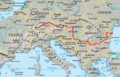
The Danube | ||
|---|---|---|
| Countries |
|  |
| Cities |
| |
| Tributaries |
| |
| See also |
| |
Authority control  |
|
|---|


