Anchorage-class dock landing ship Contents Design and development Construction and service Ship List References Navigation menu"LSD-36 Anchorage class""USS Anchorage (LSD-36)""USS Portland (LSD-37)""USS Vernon (LSD-39)""USS Fort Fisher (LSD-40)"e
Cold War amphibious warfare vessels of the United StatesAnchorage-class dock landing ships
dock landing ships (LSD)United States NavyWhidbey Island-class LSDsHarpers Ferry-class LSDsAshlandCasa GrandeAmphibious transport docksThomaston classWell dockhangarLanding Craft UtilitysLCM-8Landing Craft Mechanisedsteam turbinesshaft horsepower3"/50 Mark 33 anti-aircraft gunsUSS Anchorage (LSD-36)Fiscal yearUSS Portland (LSD-37)USS Pensacola (LSD-38)USS Mount Vernon (LSD-39)USS Fort Fisher (LSD-40)Phalanx CIWS25 mm Bushmaster cannon
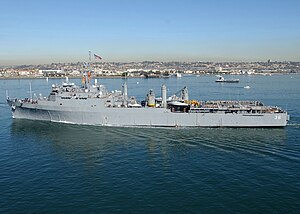 USS Anchorage (LSD-36) | |
| Class overview | |
|---|---|
| Operators: |
|
| Preceded by: | Thomaston-class dock landing ship |
| Succeeded by: | Whidbey Island-class dock landing ship |
| Built: | 1967–1972 |
In commission: | 1969– Present |
| Completed: | 5 |
| Active: | 1 (Taiwan) |
| General characteristics | |
| Type: | Dock landing ship |
| Displacement: | 14,000 long tons (14,225 t) Full |
| Length: | 553 ft (169 m) |
| Beam: | 85 ft (26 m) |
| Draft: | 20 ft (6.1 m) |
| Propulsion: |
|
| Speed: | 22 knots (25 mph; 41 km/h) |
| Range: | 14,800 nmi (27,400 km; 17,000 mi) at 12 kn (22 km/h)[1] |
| Boats & landing craft carried: | LCACs |
| Complement: | 18 officers, 340 enlisted[1] |
| Armament: |
|
The Anchorage-class dock landing ships were a series of five dock landing ships (LSD) constructed and commissioned by the United States Navy between 1965 and 1972. US Navy decommissioned all five of them by 2003. They are succeeded by Whidbey Island-class LSDs and Harpers Ferry-class LSDs.
Contents
1 Design and development
2 Construction and service
3 Ship List
4 References
Design and development
The Anchorage class of dock landing ships was built as a replacement for the remaining aging war-built LSDs of the Ashland and Casa Grande classes. Their principal intended role was to carry additional landing craft to supplement those carried by the Amphibious transport docks (LPD)s, which carried less landing craft in order to accommodate more troops and cargo.[2][3]
The Anchorage class was slightly larger than the preceding Thomaston class, but were of generally similar design, with a large Well dock aft to accommodate landing craft, and a removable flight deck fitted above the well deck to allow the operation of helicopters, although no hangar was provided. The well dock was 430 feet (130 m) long and 40 feet (12 m) wide, and could accommodate three Landing Craft Utilitys or nine LCM-8 Landing Craft Mechanised.[4] The ship could carry 375 troops compared with the 345 carried by the Thomastons,[5] while 12,000 square feet (1,115 m2) of vehicle parking space was provided.[6]
The ships were propelled by two geared steam turbines driving two shafts and giving a total of 24,000 shaft horsepower (18,000 kW). This gave a speed of 20 knots (23 mph; 37 km/h), the standard speed of the postwar US Navy amphibious fleet.[2][7][8] As built, the ships had a defensive armament of eight 3"/50 Mark 33 anti-aircraft guns in four twin mounts, while major sensors included SPS-10 surface search radar and SPS-40 air-search radar.[5]
Construction and service
The name ship of the class, USS Anchorage (LSD-36) was ordered under the Fiscal year 1965 (FY65) shipbuilding program, with three more (USS Portland (LSD-37), USS Pensacola (LSD-38) and USS Mount Vernon (LSD-39)) ordered under the FY66 program and the final ship of the class, USS Fort Fisher (LSD-40), under the FY67 programme.[9] They were laid down between 1967 and 1970 and entered service between 1969 and 1972.[10]
The fire-control directors for the 3 in guns were removed in the late 1970s, while the ships' gun armament was gradually reduced, with two mounts removed by 1990, and the remaining 3 inch guns removed by 1994.[6] Two 20mm Phalanx CIWS mounts to defend against anti-ship missiles and two 25 mm Bushmaster cannon to defend against surface targets were fitted to replace these weapons.[11]
Ship List
| Name | Builder[2] | Laid Down[2] | Launched | Commissioned | Fate |
|---|---|---|---|---|---|
USS Anchorage (LSD-36) | Ingalls Shipbuilding | 13 March 1967 | 5 May 1968[2] | 15 March 1969[2] | Decommissioned 1 October 2003[12] Sunk as target 17 July 2010[12] |
USS Portland (LSD-37) | General Dynamics, Quincy, Massachusetts) | 21 September 1967 | 20 December 1969 [2] | 3 October 1970[2] | Decommissioned 4 August 2003[13] Sunk as target 25 April 2004[13] |
USS Pensacola (LSD-38) | General Dynamics, Quincy | 12 March 1969 | 11 July 1970[2] | 27 March 1971[2] | Sold to Republic of China (Taiwan) Navy in 2000 ROCS Hsu Hai (LSD-193) |
USS Mount Vernon (LSD-39) | General Dynamics, Quincy | 29 January 1970 | 17 April 1971[2] | 13 May 1972[10] | Decommissioned 25 July 2003[14] Sunk as target 16 June 2005[14] |
USS Fort Fisher (LSD-40) | General Dynamics (Quincy) | 15 July 1970 | 22 April 1972[10] | 12 September 1972[10] | Decommissioned 27 February 1998[15] Sold for scrapping 22 May 2009[15] |
References
^ abc "LSD-36 Anchorage class". GlobalSecurity.org. 2006-07-28..mw-parser-output cite.citationfont-style:inherit.mw-parser-output .citation qquotes:"""""""'""'".mw-parser-output .citation .cs1-lock-free abackground:url("//upload.wikimedia.org/wikipedia/commons/thumb/6/65/Lock-green.svg/9px-Lock-green.svg.png")no-repeat;background-position:right .1em center.mw-parser-output .citation .cs1-lock-limited a,.mw-parser-output .citation .cs1-lock-registration abackground:url("//upload.wikimedia.org/wikipedia/commons/thumb/d/d6/Lock-gray-alt-2.svg/9px-Lock-gray-alt-2.svg.png")no-repeat;background-position:right .1em center.mw-parser-output .citation .cs1-lock-subscription abackground:url("//upload.wikimedia.org/wikipedia/commons/thumb/a/aa/Lock-red-alt-2.svg/9px-Lock-red-alt-2.svg.png")no-repeat;background-position:right .1em center.mw-parser-output .cs1-subscription,.mw-parser-output .cs1-registrationcolor:#555.mw-parser-output .cs1-subscription span,.mw-parser-output .cs1-registration spanborder-bottom:1px dotted;cursor:help.mw-parser-output .cs1-ws-icon abackground:url("//upload.wikimedia.org/wikipedia/commons/thumb/4/4c/Wikisource-logo.svg/12px-Wikisource-logo.svg.png")no-repeat;background-position:right .1em center.mw-parser-output code.cs1-codecolor:inherit;background:inherit;border:inherit;padding:inherit.mw-parser-output .cs1-hidden-errordisplay:none;font-size:100%.mw-parser-output .cs1-visible-errorfont-size:100%.mw-parser-output .cs1-maintdisplay:none;color:#33aa33;margin-left:0.3em.mw-parser-output .cs1-subscription,.mw-parser-output .cs1-registration,.mw-parser-output .cs1-formatfont-size:95%.mw-parser-output .cs1-kern-left,.mw-parser-output .cs1-kern-wl-leftpadding-left:0.2em.mw-parser-output .cs1-kern-right,.mw-parser-output .cs1-kern-wl-rightpadding-right:0.2em
^ abcdefghijk Blackman 1971, p. 509.
^ Polmar 1981, pp. 144, 146.
^ Polmar 1981, p. 146.
^ ab Polmar 1981, pp. 145–146.
^ ab Baker 1998, p. 1046.
^ Polmar 1981, p. 125.
^ Gardiner and Chumbley 1995, pp. 549–550.
^ Gardiner and Chumbley 1995, p. 619.
^ abcd Baker 1998, p. 1045.
^ Gardiner and Chumbley 1995, p. 620.
Baker, A. D. (1998). The Naval Institute Guide to Combat Fleets of the World 1998–1999. Annapolis, Maryland, USA: U.S. Naval Institute. ISBN 1-55750-111-4.
Blackman, Raymond V. B. (1971). Jane's Fighting Ships 1971–72. London: Sampson Low, Marston & Co., Ltd. ISBN 0-354-00096-9.
Gardiner, Robert; Chumbley, Stephen (1995). Conway's All The World's Fighting Ships 1947–1995. Annapolis, Maryland, USA: Naval Institute Press. ISBN 1-55750-132-7.
Polmar, Norman (1981). The Ships and Aircraft of the U.S. Fleet (Twelfth ed.). London: Arms and Armour Press. ISBN 0-85368-397-2.
Anchorage-class dock landing ships | |
|---|---|
 United States Navy United States Navy |
|
 Republic of China Navy Republic of China Navy |
|
| |
| |


