Trifle Contents History Variations Similar desserts See also References External links Navigation menuThe Good Husvvifes Ievvell"Three British Desserts: Syllabub, Fool and Trifle"the originalThe Art of Cookery"Practically Edible article on Trifle"the original"russian creole trifle cake"English Pudding and PunschtortesTraditional Trifle recipee
SausagesUtilis CoquinarioThe Forme of CuryApple pieBaconBanbury cakeCheesecakeCustardGame pieGingerbreadKippersMince pieMortisPastyPease puddingPiePottageThomas DawsonThe Good Huswifes JewellBlack puddingFruit foolPancakeSconesSyllabubTrifle (without jelly)Elinor Fettiplace (Receipt BookGervase MarkhamThe English HuswifeRobert MayThe Accomplisht CookHannah WoolleyThe Queen-like Closet or Rich CabinetKenelm DigbyThe Closet OpenedBattalia pieCurrant bunQueen of PuddingsSponge cakeSussex pond puddingSweet and sourTeaMary KettilbyA Collection of above Three Hundred Receipts in Cookery, Physick and SurgeryJohn NottThe Cooks and Confectioners DictionaryEliza SmithThe Compleat HousewifeHannah GlasseThe Art of Cookery Made Plain and EasyElizabeth RaffaldThe Experienced English HousekeeperRichard BriggsThe English Art of CookeryWilliam Augustus HendersonThe Housekeeper's InstructorBread and butter puddingChristmas puddingChutneyCottage or Shepherd's pieEccles cakeJellied eelsJugged hareKetchupMarmaladeParkinPiccalilliPork pieRoast beefSandwichScouseSuet puddingToad in the holeTrifle (with jelly)Welsh rabbitYorkshire puddingMrs RundellA New System of Domestic CookeryEliza ActonModern Cookery for Private FamiliesCharles Elmé FrancatelliThe Modern CookIsabella BeetonMrs Beeton's Book of Household ManagementBubble and squeakCauliflower cheeseCobblerDevilled kidneysFaggotsFish and chipsFull English breakfastHP SauceIce cream coneLancashire hotpotPotted shrimpsSausage rollSteak and kidney puddingBattenberg cakeEton messEve's puddingJam roly-polyLardy cakeMadeira cakeSummer puddingWorcestershire sauceElizabeth DavidA Book of Mediterranean FoodConstance SpryMarguerite PattenJane GrigsonDelia SmithRick SteinNigel SlaterKeith FloydMarco Pierre WhiteFergus HendersonGordon RamsayGary RhodesBakewell tartBeef WellingtonCarrot cakeChicken tikka masalaCrumbleKnickerbocker gloryPloughman's lunchSalad creamMichel Roux Jr.Le GavrocheHugh Fearnley-WhittingstallRiver CottageAntony Worrall ThompsonHeston BlumenthalThe Fat DuckMary BerryClarissa Dickson WrightA History of English FoodFood in EnglandList of English dishesList of English cheesesList of puddingsRationing in the United Kingdom
British dessertsEnglish cuisineCustard desserts
English cuisinedessertfruitsponge fingerssherryfortified winecustardwhipped creamjellychocolatecoffeevanillafruit foolHannah Glassegelatinsandwich cakessugarThomas Dawsonbook of English cookeryfoolJellyHannah Glassehartshorncalvesgelatin Oliver Wendell Holmesportpunschsherrymadeira wineginger alejellyScotsDrambuiewhiskySouthern UStipsy cakeChristmasChristmas puddingred winerumGermanyAustriaItaly
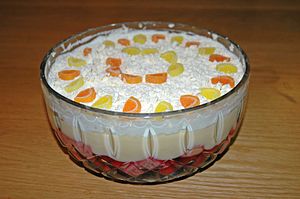 | |
| Course | Dessert |
|---|---|
| Place of origin | England |
| Main ingredients | Variable: Sponge biscuit (ladyfinger), Sherry, custard, fruit, whipped cream |
| |
 Cookbook: Trifle
 Media: Trifle
Trifle in English cuisine is a dessert made with fruit, a thin layer of sponge fingers soaked in sherry or another fortified wine, and custard. It can be topped with whipped cream. The fruit and sponge layers may be suspended in fruit-flavoured jelly, and these ingredients are usually arranged to produce three or four layers. The contents of a trifle are highly variable; many varieties exist, some forgoing fruit entirely and instead using other ingredients such as chocolate, coffee or vanilla.
The name trifle was used for a dessert like a fruit fool in the sixteenth century; by the eighteenth century, Hannah Glasse records a recognisably modern trifle, with the inclusion of a gelatin jelly. Many of the ingredients used in ancient trifles can be found in meats and other products found today. According to some scholars, trifle cakes might be the origin of modern sandwich cakes.
Contents
1 History
2 Variations
3 Similar desserts
4 See also
5 References
6 External links
History
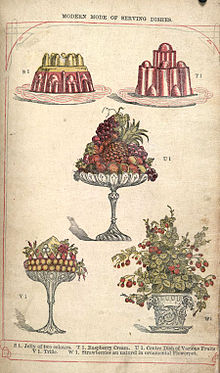
Illustrations from Isabella Beeton's Book of Household Management, 1861
The earliest use of the name trifle was in a recipe for a thick cream flavoured with sugar, ginger and rosewater, in Thomas Dawson's 1585 book of English cookery The Good Huswifes Jewell.[1] Trifle evolved from a similar dessert known as a fool, and originally the two names were used interchangeably.[2]
Jelly is first recorded as part of the recipe in later editions of Hannah Glasse's eighteenth century book The Art of Cookery. In her recipe she instructed using hartshorn or bones of calves feet as the base ingredient (to supply gelatin) for the jelly.[3] The poet Oliver Wendell Holmes wrote of trifles containing jelly in 1861.[4]
Variations
Trifles may contain a small amount of alcohol such as port or punsch, or, most commonly, sweet sherry or madeira wine. Non-alcoholic versions use sweet juices or soft drinks such as ginger ale instead, as the liquid is necessary to moisten the cake and are simply known as fruit trifle without any mention of a spirit before the name of the trifle.
One popular trifle variant has the sponge soaked in jelly when the trifle is made, which sets when refrigerated. The cake and jelly bind together and produce a pleasant texture if made in the correct proportions. Originally, a jelly, often containing fresh or preserved fruit, would have been presented separately next to the trifle 'proper'; which could be made with stiff custard and cream and delivered on the presentation plate directly from a large mould and then often elaborately decorated with sweetened and flavoured piped cream, and carefully arranged pieces of glacé fruit and angelica in a neat and regimented fashion in the Georgian and Victorian styles.
The Scots have a similar dish to trifle, tipsy laird, made with Drambuie or whisky.[5] In the Southern US, a variant of trifle is known as tipsy cake.

Layers of a trifle dessert
A trifle is often used for decoration as well as taste, incorporating the bright, layered colours of the fruit, jelly, jam, and the contrast of the creamy yellow custard and white cream.
Trifles are often served at Christmas, sometimes as a lighter alternative to the much denser Christmas pudding.
Similar desserts
A Creole trifle (also sometimes known as a Russian cake or a Russian Slab) is a different but related dessert item consisting of pieces of a variety of cakes mixed and packed firmly, moistened with alcohol (commonly red wine or rum) and a sweet syrup or fruit juice, and chilled. The resulting cake contains a variety of colour and flavour.[6] A similar dessert in Germany and Austria goes by the name of Punschtorte.[7]
In Italy, a dessert similar to and probably based on trifle is known as zuppa inglese, literally "English Soup".[8]
See also

- Cassata
- Crema de fruta
- List of custard desserts
References
^ The Good Husvvifes Ievvell. World Cat. Retrieved 2015-06-07..mw-parser-output cite.citationfont-style:inherit.mw-parser-output .citation qquotes:"""""""'""'".mw-parser-output .citation .cs1-lock-free abackground:url("//upload.wikimedia.org/wikipedia/commons/thumb/6/65/Lock-green.svg/9px-Lock-green.svg.png")no-repeat;background-position:right .1em center.mw-parser-output .citation .cs1-lock-limited a,.mw-parser-output .citation .cs1-lock-registration abackground:url("//upload.wikimedia.org/wikipedia/commons/thumb/d/d6/Lock-gray-alt-2.svg/9px-Lock-gray-alt-2.svg.png")no-repeat;background-position:right .1em center.mw-parser-output .citation .cs1-lock-subscription abackground:url("//upload.wikimedia.org/wikipedia/commons/thumb/a/aa/Lock-red-alt-2.svg/9px-Lock-red-alt-2.svg.png")no-repeat;background-position:right .1em center.mw-parser-output .cs1-subscription,.mw-parser-output .cs1-registrationcolor:#555.mw-parser-output .cs1-subscription span,.mw-parser-output .cs1-registration spanborder-bottom:1px dotted;cursor:help.mw-parser-output .cs1-ws-icon abackground:url("//upload.wikimedia.org/wikipedia/commons/thumb/4/4c/Wikisource-logo.svg/12px-Wikisource-logo.svg.png")no-repeat;background-position:right .1em center.mw-parser-output code.cs1-codecolor:inherit;background:inherit;border:inherit;padding:inherit.mw-parser-output .cs1-hidden-errordisplay:none;font-size:100%.mw-parser-output .cs1-visible-errorfont-size:100%.mw-parser-output .cs1-maintdisplay:none;color:#33aa33;margin-left:0.3em.mw-parser-output .cs1-subscription,.mw-parser-output .cs1-registration,.mw-parser-output .cs1-formatfont-size:95%.mw-parser-output .cs1-kern-left,.mw-parser-output .cs1-kern-wl-leftpadding-left:0.2em.mw-parser-output .cs1-kern-right,.mw-parser-output .cs1-kern-wl-rightpadding-right:0.2em
^ "Three British Desserts: Syllabub, Fool and Trifle". Article by Diana Serbe. Archived from the original on 13 May 2010. Retrieved 19 July 2010.
^ Hannah Glasse (1774). The Art of Cookery. Internet Archive. p. 285. Retrieved 2014-02-25.
^ "Practically Edible article on Trifle". Practically Edible; The Web's Biggest Food Encyclopedia. Archived from the original on 2 February 2011. Retrieved 19 July 2010.
^ Maw Broon (2007). Maw Broon's Cookbook. Waverley Books; (18 October 2007)
ISBN 1-902407-45-8, p111
^ "russian creole trifle cake". Delia online. Retrieved 18 February 2016.
^ English Pudding and Punschtortes. Sallybernstein.com. Retrieved on 2011-12-04.
^ "Zuppa inglese". Larousse Gastronomique. New York: Clarkson Potter. 2001. p. 1310.
External links
 | Look up trifle or trifling in Wiktionary, the free dictionary. |
 | Wikimedia Commons has media related to Trifle. |
 | Wikibooks Cookbook has a recipe/module on
|
Traditional Trifle recipe by Delia Smith


