Erythema dyschromicum perstans See also References External links Navigation menuarticle/1122807eexpanding ite
Quadrichrome vitiligoVitiligo ponctuéAlezzandrini syndromeVogt–Koyanagi–Harada syndromePiebaldismWaardenburg syndromeTietz syndromeOculocutaneous albinismOcular albinismHermansky–Pudlak syndromeChédiak–Higashi syndromeGriscelli syndromeElejalde syndromeGriscelli syndrome type 2Griscelli syndrome type 3Cross syndromeABCD syndromeAlbinism–deafness syndromeIdiopathic guttate hypomelanosisPhylloid hypomelanosisProgressive macular hypomelanosisVasospastic maculeWoronoff's ringNevus anemicusNevus depigmentosusPostinflammatory hypopigmentationPityriasis albaVagabond's leukomelanodermaYemenite deaf-blind hypopigmentation syndromeWende–Bauckus syndromeDermatopathia pigmentosa reticularisPigmentatio reticularis faciei et colliReticulate acropigmentation of KitamuraReticular pigmented anomaly of the flexuresNaegeli–Franceschetti–Jadassohn syndromeDyskeratosis congenitaX-linked reticulate pigmentary disorderGalli–Galli diseaseRevesz syndromeLentigoLentiginosisLentigo simplexLiver spotCentrofacial lentiginosisGeneralized lentiginosisInherited patterned lentiginosis in black personsInk spot lentigoLentigo malignaMucosal lentiginesPartial unilateral lentiginosisPUVA lentiginesMelasmaErythema dyschromicum perstansLichen planus pigmentosusCafé au lait spotPoikilodermaPoikiloderma of CivattePoikiloderma vasculare atrophicansRiehl melanosisIncontinentia pigmentiScratch dermatitisShiitake mushroom dermatitisAcanthosis nigricansFreckleFamilial progressive hyperpigmentationPallister–Killian syndromePeriorbital hyperpigmentationPhotoleukomelanodermatitis of KoboriPostinflammatory hyperpigmentationTransient neonatal pustular melanosisHemochromatosisIron metallic discolorationPigmented purpuric dermatosisSchamberg diseaseMajocchi's diseaseGougerot–Blum syndromeDoucas and Kapetanakis pigmented purpuraEczematid-like purpura of Doucas and KapetanakisLichen aureusAngioma serpiginosumHemosiderin hyperpigmentationArgyriaChrysiasisArsenic poisoningLead poisoningTitanium metallic discolorationCarotenosisTattooTar melanosisSkin colorSkin whiteningTanningSunless
Lichenoid eruptionsCutaneous condition stubs
skin conditionhyperpigmentedradiographic contrastpesticidesparasitesHIVleprosypintalichen planus pigmentosus
| Erythema dyschromicum perstans | |
|---|---|
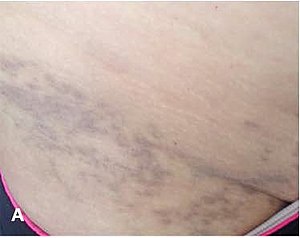 | |
| Presentation of the condition in a 20 year old female. | |
| Specialty | Dermatology |
Erythema dyschromicum perstans (EDP) (also known as ashy dermatosis, and dermatosis cinecienta) is an uncommon skin condition with peak age of onset being young adults, but it may also be seen in children or adults of any age. EDP is characterized by hyperpigmented macules that are ash-grey in color and may vary in size and shape. While agents such as certain medications, radiographic contrast, pesticides, infection with parasites, and HIV have been implicated in the occurrence of this disease, the cause of this skin disease remains unknown.
EDP initially presents as grey or blue-brown circumferential or irregularly shaped macules or patches that appear. While the lesions of EDP are generally non-elevated, they may initially have a slight raised red margin as they first begin to appear. These lesions usually arise in a symmetric distribution and involve the trunk, but also commonly spread to the face and extremities. EDP does not usually have symptoms beside the macules and patches of discolored skin; however, some itching in these areas may occur.
Because EDP is an uncommon disease of the skin, it is important to consider other skin diseases that may resemble erythema dyschromicum perstans, such as infectious diseases (i.e. leprosy or pinta), reaction to drugs, post inflammatory hyperpigmentation, or lichen planus pigmentosus.
There is no cure for EDP. While multiple various topical and systemic therapies have been tried, none have been consistently successful. In children, spontaneous resolution of EDP over the course of months to years is possible; however, this outcome is less likely if EDP presents in adulthood.[1]:224
See also
- Lichen planus
- List of cutaneous conditions
References
^ James, William D.; Berger, Timothy G.; et al. (2006). Andrews' Diseases of the Skin: clinical Dermatology. Saunders Elsevier. ISBN 0-7216-2921-0..mw-parser-output cite.citationfont-style:inherit.mw-parser-output .citation qquotes:"""""""'""'".mw-parser-output .citation .cs1-lock-free abackground:url("//upload.wikimedia.org/wikipedia/commons/thumb/6/65/Lock-green.svg/9px-Lock-green.svg.png")no-repeat;background-position:right .1em center.mw-parser-output .citation .cs1-lock-limited a,.mw-parser-output .citation .cs1-lock-registration abackground:url("//upload.wikimedia.org/wikipedia/commons/thumb/d/d6/Lock-gray-alt-2.svg/9px-Lock-gray-alt-2.svg.png")no-repeat;background-position:right .1em center.mw-parser-output .citation .cs1-lock-subscription abackground:url("//upload.wikimedia.org/wikipedia/commons/thumb/a/aa/Lock-red-alt-2.svg/9px-Lock-red-alt-2.svg.png")no-repeat;background-position:right .1em center.mw-parser-output .cs1-subscription,.mw-parser-output .cs1-registrationcolor:#555.mw-parser-output .cs1-subscription span,.mw-parser-output .cs1-registration spanborder-bottom:1px dotted;cursor:help.mw-parser-output .cs1-ws-icon abackground:url("//upload.wikimedia.org/wikipedia/commons/thumb/4/4c/Wikisource-logo.svg/12px-Wikisource-logo.svg.png")no-repeat;background-position:right .1em center.mw-parser-output code.cs1-codecolor:inherit;background:inherit;border:inherit;padding:inherit.mw-parser-output .cs1-hidden-errordisplay:none;font-size:100%.mw-parser-output .cs1-visible-errorfont-size:100%.mw-parser-output .cs1-maintdisplay:none;color:#33aa33;margin-left:0.3em.mw-parser-output .cs1-subscription,.mw-parser-output .cs1-registration,.mw-parser-output .cs1-formatfont-size:95%.mw-parser-output .cs1-kern-left,.mw-parser-output .cs1-kern-wl-leftpadding-left:0.2em.mw-parser-output .cs1-kern-right,.mw-parser-output .cs1-kern-wl-rightpadding-right:0.2em
External links
| Classification | D |
|---|---|
| External resources |
|
 | This cutaneous condition article is a stub. You can help Wikipedia by expanding it. |


