NGC 1806 References External links Navigation menu1927BHarO.849...11S"NGC 1806"A Great Ball of Starsexpanding ite
Globular clustersNGC objectsDorado (constellation)Star cluster stubs
globular clusterLarge Magellanic CloudDoradoJohn Herschel
| NGC 1806 | |
|---|---|
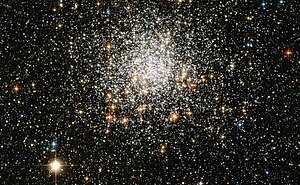 NGC 1806 image taken by the Hubble Space Telescope Credit: ESA/Hubble & NASA | |
| Observation data (J2000 epoch) | |
| Class | VI[1] |
| Constellation | Dorado (constellation) |
| Right ascension | 05h 02m 11.180s[2] |
| Declination | −67° 59′ 05.89″[2] |
| Physical characteristics | |
| Other designations | NGC 1806, KMHK 462, [SL63] 184 |
NGC 1806 is a globular cluster located within the Large Magellanic Cloud within the constellation of Dorado (the dolphin-fish), an area of the sky best seen from the Earth's southern hemisphere. It was discovered in 1836 by the British astronomer John Herschel.
References
^ Shapley, Harlow; Sawyer, Helen B. (August 1927), "A Classification of Globular Clusters", Harvard College Observatory Bulletin, 849 (849): 11–14, Bibcode:1927BHarO.849...11S.mw-parser-output cite.citationfont-style:inherit.mw-parser-output .citation qquotes:"""""""'""'".mw-parser-output .citation .cs1-lock-free abackground:url("//upload.wikimedia.org/wikipedia/commons/thumb/6/65/Lock-green.svg/9px-Lock-green.svg.png")no-repeat;background-position:right .1em center.mw-parser-output .citation .cs1-lock-limited a,.mw-parser-output .citation .cs1-lock-registration abackground:url("//upload.wikimedia.org/wikipedia/commons/thumb/d/d6/Lock-gray-alt-2.svg/9px-Lock-gray-alt-2.svg.png")no-repeat;background-position:right .1em center.mw-parser-output .citation .cs1-lock-subscription abackground:url("//upload.wikimedia.org/wikipedia/commons/thumb/a/aa/Lock-red-alt-2.svg/9px-Lock-red-alt-2.svg.png")no-repeat;background-position:right .1em center.mw-parser-output .cs1-subscription,.mw-parser-output .cs1-registrationcolor:#555.mw-parser-output .cs1-subscription span,.mw-parser-output .cs1-registration spanborder-bottom:1px dotted;cursor:help.mw-parser-output .cs1-ws-icon abackground:url("//upload.wikimedia.org/wikipedia/commons/thumb/4/4c/Wikisource-logo.svg/12px-Wikisource-logo.svg.png")no-repeat;background-position:right .1em center.mw-parser-output code.cs1-codecolor:inherit;background:inherit;border:inherit;padding:inherit.mw-parser-output .cs1-hidden-errordisplay:none;font-size:100%.mw-parser-output .cs1-visible-errorfont-size:100%.mw-parser-output .cs1-maintdisplay:none;color:#33aa33;margin-left:0.3em.mw-parser-output .cs1-subscription,.mw-parser-output .cs1-registration,.mw-parser-output .cs1-formatfont-size:95%.mw-parser-output .cs1-kern-left,.mw-parser-output .cs1-kern-wl-leftpadding-left:0.2em.mw-parser-output .cs1-kern-right,.mw-parser-output .cs1-kern-wl-rightpadding-right:0.2em
^ ab "NGC 1806". SIMBAD. Centre de données astronomiques de Strasbourg. Retrieved 8 January 2019.
External links
A Great Ball of Stars — ESA/Hubble Picture of the week
 | This star cluster–related article is a stub. You can help Wikipedia by expanding it. |


